

Step decomposition#
This section explains how to divide your workflow into steps and how steps relate to UI pages.
One step per logical concern#
Prefer one step per logical concern (setup, solving, results). Each step should own a cohesive set of fields that belong to the same phase of the workflow.
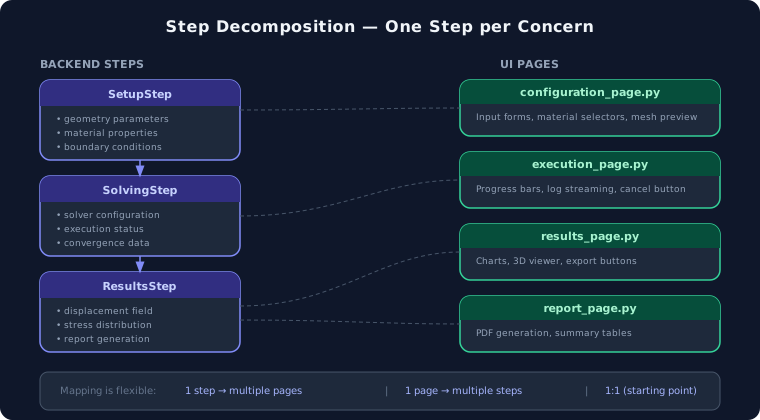
Start with a one-to-one mapping between steps and UI pages, but keep the relationship flexible:
One step can span multiple pages (for example, configuration, execution, and results views over the same data).
A single page can aggregate content from multiple steps.
class SetupStep(StepModel):
    """Owns geometry and material configuration."""

    length: float = 1000.0
    diameter: float = 50.0
    material: str = "steel"


class SolvingStep(StepModel):
    """Owns solver execution and progress tracking."""

    solver_type: str = "direct"
    progress: float = 0.0
    is_running: bool = False


class ResultsStep(StepModel):
    """Owns computed outputs and report generation."""

    max_stress: float = 0.0
    deflection: list[float] = []
    report_ready: bool = False
When to merge versus split steps#

Merge when:
Simple workflow with few parameters.
All inputs and outputs share the same context.
A single user role handles the entire flow.
class UnitConverterStep(StepModel):
    """Simple enough to keep in a single step."""

    value: float = 0.0
    from_unit: str = "mm"
    to_unit: str = "in"
    converted_value: float = 0.0

    @transaction(self=StepSpec(download=["value", "from_unit", "to_unit"], upload=["converted_value"]))
    def convert(self) -> None:
        conversion_factors = {"mm_to_in": 0.03937}
        key = f"{self.from_unit}_to_{self.to_unit}"
        self.converted_value = self.value * conversion_factors.get(key, 1.0)
Split when:
Users need to inspect intermediate outputs.
Different phases require different expertise (for example, an electrical engineer runs the electro-magnetic simulation, then a mechanical engineer runs the thermal simulation).
Setup and results need different UI (for example, a page for CAD import and meshing, a page for solver configuration and results, and a page for post-processing and visualization).
class ElectromagneticStep(StepModel):
    """EM simulation — owned by electrical engineer."""

    frequency: float = 1e9
    power_loss: float = 0.0

    @transaction(self=StepSpec(download=["frequency"], upload=["power_loss"]))
    def solve_em(self) -> None:
        self.power_loss = compute_em_losses(self.frequency)


class ThermalStep(StepModel):
    """Thermal simulation — owned by mechanical engineer."""

    max_temperature: float = 0.0

    @transaction(
        self=StepSpec(upload=["max_temperature"]),
        electromagnetic=StepSpec(download=["power_loss"]),
    )
    def solve_thermal(self, electromagnetic: ElectromagneticStep) -> None:
        self.max_temperature = compute_thermal(electromagnetic.power_loss)